


The initial value problem for a system of differential equations is to be solved by the well-known Runge-Kutta method. The C-XSC program is very similar to the mathematical notation. Dynamic vectors are used to make the program independent of the size of the system of differential equations to be solved.
Consider the first-order system of differential equations

If the solution Y is known at a point x, the approximation Y(x+h) may be determined by the Runge-Kutta method:
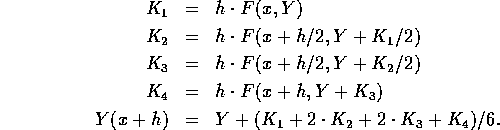
For example, we solve the system

The program computes an approximation of the solution at the points

starting at given

(here:

).
#include "rvector.hpp"

rvector F(real x, rvector Y)
{ // Function definition
  rvector Z(3);               // Constructor call

  x    =  0.0;                // F is independent of x
  Z[1] =  Y[2]  * Y[3];
  Z[2] = -Y[1]  * Y[3];
  Z[3] = -0.522 * Y[1] * Y[2];
  return Z;
}

void Init(real& x, real& h, rvector& Y)
{                             // Initialization
  Resize(Y,3);                // Resize dynamic array
  x    = 0.0;   h    = 0.1;
  Y[1] = 0.0;   Y[2] = 1.0;  Y[3] = 1.0;
}

main()
{
  real x, h;                  // Declarations and dynamic
  rvector Y(3), K1(3), K2(3), K3(3), K4(3); // memory allocation

  Init(x, h, Y);
  for (int i=1; i<=3; i++) {  // 3 Runge-Kutta steps
    K1 = h * F(x, Y);         // with array result
    K2 = h * F(x + h / 2, Y + K1 / 2);
    K3 = h * F(x + h / 2, Y + K2 / 2);
    K4 = h * F(x + h, Y + K3);
    Y  = Y + (K1 + 2 * K2 + 2 * K3 + K4) / 6;
    x += h;
    cout << SetPrecision(18,16) << Dec;     // I/O modification
    cout << "Step:  " << i << ",  "
         << "x =    " << x << endl;
    cout << "Y =    " << endl << Y << endl;
  }
}